Tuesday, 1 April 2014

Northern Spain

Once in Spain we went to the nearest petrol station to fill our thirsty tank.  We had topped up in Portugal earlier in the day just to see us over the border and the price difference between these two stations was 20 cents per litre.  It adds up to a lot when you are putting in about 65 litres of fuel.  Our stop for the night was in Pontevedra where we headed to the aire on the outskirts of town.  Having left the masses of motorhomes in Portugal we were on our own for the night.

In the morning we tried to find a park on the street as we felt there was opportunity for break ins at the carpark.  We couldn't space anywhere the town as it was crammed with cars, so it was back to the car park and I went into town whilst Dale babysat the van.  Pontevedra was a nice enough place, but for me certainly didn't have any wow factor.  There were some lovely churches and buildings and I had a quick look through the provincial museum.


Dale decided he was happy to move on so we headed out to the coast from there after a lunch stop at the Monastery at Poio (which is across the river from Pontevedra).  The beaches and landscape on the coast was some of the best scenery we had seen in Spain- white sand beaches, sheltered coves and calm sea waters.

We did a walk at the National park of Carreiron, which is actually on an island, very close to the mainland, connected by a bridge.  The scenery here was fantastic (it was somewhat ruined by the lost fishing equipment that was thrown up on shore). Dale even found a dead dolphin with rope around it, which we guessed may have been dumped due to its position on the beach.


Next was Santiago de Compostela and we parked in a suburb of Milladoiro and caught the bus into town.  Santiago draws pligrims to its Cathedral and is the end of a long pligrimage route across northern Spain.  It had a very nice old town and we had a pleasant few hours strolling the streets.The region boasts its own wines, cheeses and almond cake.  We were ushered into a shop for some free trials of all of these, unasked for.  We were given a somewhat hard sell and decided not to buy the 9 euro bottle of wine on offer (just not in the budget).  The attendant wasn't too happy about this as we left the shop.


We went to Lugo, an hour and a half away for the night.  The aire is located 15 minutes walk from the old town.  Lugo has town walls which run uninterrupted around the old town.  Lugo has an impressive Cathedral and their Provincial museum was a real find.  It had an impressive collection, very well laid out.  It is located in a former monastery and focuses on finds from the local Galicia area.


We finished our visit with a walk along the wall.  Some aspects of Lugo are very good.  You can tell there has been money spent on the upkeep of some buildings, the museum and public spaces, but every so often there is a boarded up building and grafitti.  Plus, like many European countries, the Spanish do not know how to pick up dog poo. Dale: Many of them treat it like they are setting up an easter egg hunt (wrap it up then 'hide' it somewhere for someone to find later).  They either leave it on the ground, or pick it up and put it in a bag, but then fail to actually put it in a rubbish bin, littering the poo and plastic instead.


Our destination the following day was Leon.  We stopped at the remains of a Roman gold mine called Las Medinas on the way.  During the 1st and 2nd century these gold mines were the most important in the Roman empire and yielded 6,000 kgs a year.  The site is pretty spectatular.


We also stopped in Astorga, which has a Cathedral and is also part of the pilgrimage route.


At Leon the aire was opposite a shopping mall (yay).  Unfortunately there weren't many shops of interest, but there was wifi.  We have found the aires fantastic yet again, managing to stop every night in one and use them mostly for our city sightseeing.  The majority of motorhomes around are Spanish registered.  We spent a morning looking around Leon.  We didn't go into the Cathedral but the outside is stunning.  There are some remaining town walls and lucky for us when we went over to the Town Hall there was a fruit and vegetable market going on in the square outside (Saturday morning).  We bought a few vegetables and some oranges, then tried to buy some Jamon (cured pork product), a speciality in Spain.  This proved too hard with the language barrier, so we thought we would just asked how much a pre packaged amount was.  We stood waiting in line for a couple of minutes before realising that we needed to have taken a numbered ticket and wait to be called to the counter.  The two people served before us didn't do this and when we remained ignored, we gave up.  We purchased some later at the supermarket.


That afternoon was spent driving and we arrived in Logrono about dinner time.  We didn't feel Logrono needed a visit so we left in the morning to drive 1 hour to Pamplona, known for its running of the bulls festival.  On this drive we saw hikers walking the pligrimage route, about 10 of them in total.

Once in Pamplona we saw the temperature on various advertising boards as we drove to the car park.  They ranged from 2-4 degrees!  We are not used to this, considering we had two weeks of sun in Portugal!  Once parked we walked and then used the funicular to get to the town which was at the top of the hill.  We first tried to find the information centre, but after following contradicting signs back and forth round the main square, we had to admit defeat (I was rather annoyed by this stage and it was raining hard).


The rain cleared and we had a walk around the bull ring.  The running of the bulls is a 800 metre race, through the city streets to the bull ring at the end.  It is run at 8am, and follows an old traditional of bringing the bulls through to the bull ring for that night's fight.  We followed the route in reverse.  The route is straight apart from a 90 degree turn (which the information sign said caused many of the bulls to crash into the fencing) and a steep uphill at the beginning.  The turn and the steepness at the start give the runners a much needed advantage.  We also ducked into the museum which was free on Sundays to see their Roman mosiac collection.  They had a huge collection and even one that was about 8 metres square and it was mostly complete.
The end of the 'Running of the bulls'


The beginning of the run

We then drove 4.5 hours to Pau in France.  Topping up with petrol (about 10-20 cents a litre cheaper in Spain) we crossed over the Pyranees.  What a fantastic drive this turned out to be.  Approached the tunnel where the border crossing is, we had seen some snow in Spain, but coming out of the 8km or so long tunnel into France we were greeted with much more.  The mountains and villages looked lovely and it continued to snow until we dropped down in altitude.  Once in Pau you could see the snowy mountains in the distance but it still made for another chilly night in the van.


Wednesday, 26 March 2014

Portugal- Monasteries and Porto

From Obidos we drove to Alcabaca.  We hadn't planned to stop, but changed our minds when we saw the impressive monastery there.  The church part is free to enter so I went inside for some photos and to see the tombs of King Pedro I and his love.  She was unfortunately ordered to be killed by Pedro I's father, as she was Pedro I's wife's lady in waiting- quite scandalous and sad for her really.  The monastery was beautiful and amazing, it is absolutely huge and has such a lovely ambience inside.


We then went on to Batalha, where there is another monastery, also UNESCO, which is very similar to Alcabaca's.  This time we paid to go into the monastery.  Two highlights for me were the chapel where many Royal tombs are located, and also the grave of the unknown soldier.  Two soldiers were standing either side, and it was very moving.  We feel like we are following Queen Elizabeth's 1957 tour of the country, as we saw the carriage she rode in at the Coach museum, the boat she sailed in at the Maritime museum and we saw photos of her visiting the monastery in Batalha.

The stain glass windows reflecting on the floor


It was then onto Coimbra where we parked at an aire with about 15 other motorhomes.  We have found Portugal to be extremely motorhome friendly, which many serviced aires and free parking places, as well as many other motorhomers about.  Coimbra is the University town of Portugal.  From the 12th century this title floated back between Coimbra and Lisbon, until in the 16th century when the University settled in Coimbra for good.  Again there was beautiful views of the town from across the river and some steep roads to climb to the University which is at the top of the hill.  It was a pleasant couple of hours exploring the town before we drove to Porto.


The University

Dale outside the University library


At Porto we stayed at Campismo de Salgueiros, one of a number of campsites located near the beach and it was a 20 minute bus journey from Porto.  The campsite was an astonishingly cheap  4.75 euros a night for 2 people without electric and including showers.  That afternoon we walked along the waterfront to the estuary where the river Douro meets the sea. There were a lot of seagulls and shags at the estuary.  Because it was a sunny Sunday there were hordes of locals strolling the foreshore promenade and having drinks at cafes. In the morning we tried to catch the bus and it seemed the timetable may have been reduced as the one we went out for never arrived so we had a little wait for the next one spot on time.

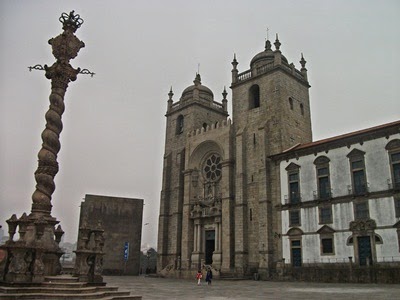
Dropped right on the edge of the historic Porto district, it was only a short walk to the Cathedral and Information Centre. Porto is hilly which means you get views from all over the place and the Cathedral is one such location (as cathedrals go it was just okay).  There was some sort of service on when we visited with about half a dozen attendees. The historic centre of Porto is wonderful in the sense that it looks so old, you almost feel the history dripping off it.  This retention of the historic feeling appears to be linked to the residents of the inner city living in what looks like near poverty.  We walked through the narrow Ribiera streets with a mixture of trepidation and intrigue.


We could see all the Port cellars across the river on the Gaia side so went for a stroll along the front.  We then returned onto the Porto side and made a circuit around the historic district viewing various sites (mainly churches) before getting the bus back.


The next day was devoted to getting to Pontevedra in Galicia, Spain via Viana do Castello in Portugal.  We were staying off toll roads and this meant initially a slow journey up the built up  coast north of Porto, before a hilly, windy journey inland north of Viana do Castello.  The major highlight of the day was getting McDonalds for lunch in a mall and finding that the mall offered excellent free WIFI and powerpoints (which was necessary as our computer battery is dying and last about 30 minutes currently).


Tuesday, 18 March 2014

Portugal- Lisbon, Sintra and Obidos

For Lisbon we headed to a campsite in Costa de Caparica.  We arrived early afternoon, so after a quick lunch we got the bus into Lisbon.  The route took us over the April 25 bridge.  They call it a sister bridge to the Golden Gate in San Francisco and it is very similar.  We spent the next 3 hours wandering around, up to the castle for views, to the Se Cathedral and to the square called Terreiro do Paco.  We didn't see any signs for the tourist information office, and not having looked up it's location in advance, we were unable to find it and pick up a map.  I think we found most major sights, and headed back to the camp via Belem using the train, ferry and bus (1 hour journey).


The following day we got on the bus at 9am to the Trafaria ferry terminal and then caught the ferry to Belem.  We spent the whole day here.  It is a lovely area of Lisbon with monuments overlooking the water and the UNESCO site of Jeronimos Monastery. As well as checking out these we went to two museums.  The first was the Coach museum, a collection of Royal carriages from the 16th-19th centuries.  It is housed in the 18th century Royal Palace riding school, which itself is a wonderful building.


Our second museum was the Maritime museum which was huge!  It had endless ship models, instruments, paintings, uniforms and boats on display.  We spent 2 hours there and could have spent longer, but our brains couldn't compute anything more to do with boats.  We both agreed that we enjoyed learning about the 15th and 16th century exploration that the Portuguese did and was the main reason we had gone to the museum.

The monastery

The tower of Belem

A Henry the navigator statue at the Maritime museum


After Lisbon we headed across the April 25 bridge and half an hour north to Sintra.  Sintra is a beautiful town and the location of several castles.  We parked in town for a walk to see the National Palace of Sintra.  Dale must have been feeling adventurous as we then drove to the Pena Palace and Monserrate Park, which were on steep narrow roads.  We thought that surely these must be one way roads as there was provision for parking on them too.  At one point another car came the other way, so I'm still not sure.  There is also a bus that does this route to ferry passengers from the various Palaces back to Sintra.

The April 25 Bridge


The National Palace of Sintra


Next on the express tour of Portugal was Obidos, a beautiful town on top of a hill.  Portugal is very hilly so to date we have seen many beautiful town views.  A highlight of this town for me was the Santa Maria church which had stunning tiles on the walls.  The town walls afforded great views of the town and there was also a chocolate festival going on.  Unfortunately most of the action was in a special area for 7 euro entry each, but we managed to see special stalls that shop owners had set up and a cake decoration contest for free.

The Santa Maria Church


Some of the entrants in the cake decorating competition

The view from the town walls