Sunday, 15 September 2013

Lithuania

Dale:  Having used up all but 1 cent of our Latvian money we crossed in Lithuania and made our first stop a place called the Hill of Crosses.  This is a religious site where people have been coming since the 19th century and leaving/erecting crosses.  Currently there are approximately 200,000.  It sounds a lot- but they are very tightly packed, with crosses hanging off other crosses in some cases.  It may initially have started as a rememberance to people that died in the uprising in 1863 and it continued as a show of defiance to the Tsarist rule. During the soviet occupation they attempted to destroy it and they removed some but again the Lithuanians would erect crosses in defiance of the Soviet occupation.  Today there are strict rules about adding crosses (eg they must be wooden)


We headed into the nearby town of Siauliai to visit the information centre and get some Lithuanain Litai, their currency. We ended up doing a spot of shopping and while having a spot of lunch in the carpark a friendly Lithuanian spotted our New Zealand sticker and flag in the back window and we struck up a conversation.  Turned out his hobby is sailing and he spends much of his time sailing in various parts of the world.  Currently he is based in Argentina where he works as a fishing tour guide.  He enjoyed the opportunity to practise his English and we enjoyed the friendly banter.  I was slightly taken aback by his rather unabashed racist comments a couple of times.  It was the sort of stuff sometimes people may think but would never dare say.  It appeared clear that Lithuanians really don't like the Russians (no surprises there).  He was also somewhat critical of the Lithuanians in terms of crime (which given our recent experience has further heighten our concern).  He proclaimed with a strange sort of pride/joke that Lithuania provided the UK with the second highest number of immigrant criminals behind Poland and he pointed out Poland is 10 times the size. When we explained that we met a Lithuanian tourist in Ireland he was very skeptical, he pretty much insisted that he must have been an illegal immigrant (which in fairness there is a problem with illegal Lithuanians in other countries).  When I probed him on the issue of crime in Lithuania he said probably many Lithuanian criminals are in Western Europe because there are more wealthy targets, he joked there is nothing to steal here.  Which from our observation seems a little harsh, since independance the Baltic States are Europeanising rapidly and wealth appears present (saw a Bently today).  It is unfortunate however that within each of the country there is a large element of people just out for what they can get.  It also makes us angry that often tourists are seen as someone to exploit.

We decided to head straight to Vilnius as it was the last night the campsite there was open for the season.  We had found a guarded car park online that we wanted to use the following morning after checking out.  However when we got there, the guarded aspect had been replaced by a machine.  After Tallinn, we weren't comfortable leaving the van there.  With only the parking symbols on our map to go by, we decided to check out other spots.  We luckily found another one, about 10 minutes walk to the edge of the old town, guarded by a man and his viscious looking dog.  Vilnius has an old town in a basin and the hills between it and the new/modern town provide excellent views.  Neither view is as significant as say Salzburg or Prague but well worth a look.  We took the funicular (like a cable car) up to the Gediminas Tower for our first view, then walked down and up the next hill which has a local monument called The Three Crosses on it.  This also was actually totally destroyed by the soviets and was only rebuilt in 1989.  The rest of the afternoon was spent exploring the Old town.  Some highlights were:  Cathedral Square, Vilnius University, the Presidential Palace, the Gates of Dawn, St Annes Church and the Jewish Quarter.


Nicky:  That evening we decided to treat ourselves with a meal out.  We headed 500m down the road to a restaurant that the guard at the car park had recommended.  Afterwards, we summed up that we enjoyed our meals and had a great time, but wouldn't return and order those dishes again.  I had Russian pancakes, with minced beef, cheese, spinach and eggplant, and Dale had Pork stuffed with chicken (the pork aspect was minced, and a bit strange), mashed potato and salad.  We shared Chicken and plum dumplings to start.  It was a reasonably priced meal, with 1 starter, 2 mains and 2 drinks for 17 euros.


We left Vilnius the following morning.  We had been tossing up spending another day and going to the National Museum, but I think we were both ready to head out of the city into the peace of the countryside.  We went to Kernave, which written sources from 1279 say that it is the first capital of Lithuania.  Just outside Kernave we stopped at an oak forest and did a 2.2km circular walk.  It was an easy walk- all on flat boardwalk.  Dale was on the look out for the wildlife they proclaim to have- bats, frogs, elk, wild boar, beetles.  We saw some very small frogs, and one larger one which jumped off the boardwalk in front of us and gave me a fright!  The path was also dotted with wood carvings (about 30 or so) used to show the significance of the oak trees.


Our destination in Kernave was the 5 hill forts.  Inhabitants have been in the area since 8,000 BC and the site was given UNESCO status in 2004.  We walked up and down the mounds, but declined a visit to the museum, as we had been to similar sites in Denmark and Ireland.


It was early afternoon, so we decided to head to Trakai, which had been an ancient capital as well.  Also on the outskirts of Vilnius, and about 20-30 minutes away from Kernave.  The castle on an island in the lake is very picturesque when approaching the town.  We had been passing many half full carparks on the way in and we'd got to the stage where we thought we should pull in, when we saw locals selling parking spaces in their front yards.  Dale checked the council prices.  The locals were offering a good rate of 5 litras (1.50 euro) and we felt somewhat more secure using them, as atleast while they were tauting for more business, they would be present in their yard.  When arriving at the lake front we instantly noticed how different the two sites we had seen today were.  In Kernave, there were a few people going to the mounds, at Trakai they were coming in by the bus load.  In total we spent 2.5 hours at the castle, and saw every room.  It was our most expensive attraction yet at 15 litras (a reasonable 4.40 euros each).  Part of the castle has panels explaining the history up to present day.  Restoration has been off and on for the last 100 years, including during the Soviet time.  I found this interesting as restoration of buildings wasn't something they prioritised.  The other part of the castle housed the Trakai History museum.  There were several rooms showcasing all sorts of objects.  My favourite was the final room where they had fans, parasols, trinket boxes and vases on display.


The next day we went to the Open air museum, located near Lithuania's second city Kaunas.  Our guide 'helpfully' listed the address as their administration building in Rumsiskes.  One of the school children waiting for a bus, pointed us in the right direction on the outskirts of town.  The museum spans 176 hectares, and with only a few cars in the car park, we knew it wouldn't be crowded with tourists.  Overall the site is nice, with 80 or so different buildings, and the park separated into different areas to represent parts of Lithuania.  The staff were extremely rude and lazy however, it was demanded that we pay for parking at the cash desk, after no one was even in the booth in the car park to collect money.  Also the room guides were either talking, knitting or playing with their phones.  I don't think they realise that a smile is free!  The sun was shining and we walked around for about 4 hours, ignoring those aspects of the park that we thought could be improved upon.


That night we drove into Kaunas to check out car parks.  Unfortunately at night, the city looked rough and luckily I had looked up the address of the Police station in advance, as our GPS like in Tallinn, didn't have the right location.  We saw a Policeman when we arrived, who said it was safe and didn't think that Kaunas had above average car crime.  Next to the Police station was a guarded car park, so we felt reasonably secure being there for the night, and in the morning we paid the attendant and spent time exploring the old town.  The guide book we picked up the next day described car crime as a 'national past time', so I think it always pays to be careful.


We left Kaunas at lunch time after seeing several churches, the castle and town hall.  We have been subdueing our cravings for kiwi pies, by buying the local pastries called kibinas.  We aren't sure what the traditional fillings are- but we have had minced chicken, and liver and onion (we think!).

We went to the Ninth fort, which is on the outskirts of Kaunas.  Again another very quiet tourist destination with only a handful of people around on a Thursday afternoon.  It was for a long time the site of a hard labour camp, and during WW2 a site for extermination of Jews.  There are memorials to the Jewish and Soviet victims, and a field inwhich they are buried.  The site has two museums, one about the occupations and the other in the fort itself, which covers the prison site, and also mentions the Jews.  We enjoyed the fort museum the most, and was really interesting going into the fort.  I thought it had been preserved well, as you could sense the history.


We were heading south before driving into Poland, and stopped at a lovely town called Bistonas.  There is a mound there, 30 metres above the town which offers pleasant views over the river.  It was inhabited around the 15th century and had a hill fort on top.

The driving here in Lithuania is something to mention.  Again our Kaunas city guide sums it up well, describing driving next to a local as an adventure with 'lashings of tailgating, cutting lanes and dangerous overtaking manoeuvres.  It comes as no great surprise to learn that Lithuania has the highest rate of road fatalities in the European union'.  It also describes the streets of Kaunas as 'a frightening squiggle of badly signposted asphalt full of holes and populated by a high percentage of drivers who give the impression they never took a driving test'.  On our drive out of the city  we also saw mini buses.  They follow the bus routes, and will pick up and drop off passengers along the route for a slightly higher fee, but are able to get there faster and more comfortably as they can weave in and out of traffic and don't have to stop everywhere.

Sunday, 8 September 2013

Latvia

When we left you in our last blog we had just visited the town of Valga-Valka, split by the Estonian/Latvian border.  We hadn't gone much further south before we were signaled to pull over by a parked Police car.  They wanted to check our passports and Dale's drivers license.  Upon hearing that they wanted to see the passports, I was all ready to get the computer out to show evidence of the New Zealand Schengen waiver agreements, however this wasn't required and we were quickly on our way again.  After 3 months of no passport checks, we have just had two in quick succession.

Our destination was Cesis.  Our pamphlets described it as one of the best towns in Latvia, which we feel may have been stretching it a bit, however we enjoyed seeing the Victory monument, St John's church and seeing a building which during Soviet occupation (1945-1990) was a Cheka- a place where people were interrogated, tortured and killed.  The main attraction in Cesis is the castle.  There were several price brackets depending on what you wanted to see.  We chose to explore the castle ruins and climb the west tower.  The special twist to climbing the tower, is that you are given a candle lantern to take with you as it is dark in parts of the staircase.

Cesis Castle


We have come to realise that being away for so long requires us to take time out.  Not to relax- but to organise our New Zealand banking, and unfortunately at the moment, to organise our insurance claim.  So when we picked up a strong wi-fi signal the next morning in the countryside outside Cesis, we used the opportunity to catch up on things back home.  We also had an Australian couple in a UK registered motorhome pulled up beside us.  We had fun talking to Marilyn and Andrew as we had so much common ground, and we ended up talking to them for 3.5 hours!  They spend 6 months out of every year in UK and Europe and have done so for 7 years.  It sounds like the ideal retirement to Dale and I.

We had planned on seeing the Gauja National Park that afternoon on our way to Riga, but with limited time, we decided it was more important to reach Riga at a reasonable time.  We arrived about 6.30pm, with Dale doing well to negotiate the roads and traffic.  We had decided to stay at Riga City Camping for the night, as we needed the facilities and Matt and Sarah had arrived the night before.  It gave us the opportunity to catch up and say goodbye to them, as they are going at a faster pace than we are.

The following morning we moved the van 500 metres down the road to a secure, guarded car park.  We set off for the day sightseeing, and I tried to put my worry about the van to one side, as at least this car park was guarded and had a entry barrier.  The van was fine and we had an enjoyable day in Riga.  We visited two museums- the War museum and the Occupation museum, saw some lovely architecture and sussed out the central markets (located in old Zeppellin hangers).  We decided we would return the next morning and buy some meat and vegetables as the prices were once again good value.  It was a sunny day, ideal for sightseeing and we cracked out the shorts and t shirts again.

Dale cruising on the way to Riga

Traffic in Riga- 100 metres from the campsite, the parked cars on the right are blocking our lane


Riga


We set off at 8.30am the next morning and walked to the markets.  Like Tartu, we spent a similar amount and returned with vegetables, chicken, bread and pastries.  I commented to Dale how yesterday, when we weren't buying goods I felt slightly intimidated with the hustle and bustle.  But when we were shopping, it was a different experience.  We wanted to visit the Zana Lipkes memorial, located near the campsite.  We drove around a bit and found it.  It is very close to the guarded car park, but our time there was up, and we found a park near the memorial.  During WW2 the Lipskes family saved 55 Jews in their underground shelter, and by transporting them to other shelters in the countryside, with the help of friends.  The Germans never found the bunker.  The museum is located next to the Lipkes family home, where Zana's daughter in law still lives.  We were treated to a personal guided tour for 45 minutes and learned a lot about this amazing story.  We thoroughly enjoyed our experience and were happy to add to the donation box, as this attraction is free.

We left Riga and went to nearby Jurmala, a beach resort area.  We parked and walked through forest to the beach.  The sand was white, and we sat on towels in amongst the dunes to shelter from the wind.  Dale braved the chilly waters and had a swim.  I was starting to regret not putting on my togs, but it was pretty cold and I probably couldn't have swum for long if I did.  We spent a relaxing 2-3 hours there, and returned to the van to drive south to Jelgava, where we stopped for the night.

Jelgava was a town on the improve, they have had significant investment to improve their public space (riverside waterfront) and the works are still ongoing.  Where once you had a depressing sad soviet town you now get energy and vibrancy.  It is still a long way from being a must see tourist stop but is pleasant enough for a quick visit.


The Holy Trinity tower- the church was damaged in WW2, then blown up by the Soviets.  They kept the tower as it was useful for Military purposes.


At the top of the Holy Trinity tower


From Jelgava we headed to Rundale Palace which is one of the major tourist destinations in Latvia.  It was the summer residence of the Duke of Courland back in the day when such existed.  It is progressively being restored and 48 rooms, about 1/3, are open and they are also in the midst of the restoration of the formal french style garden which is coming on very well.  The entry fee is about right and we found we weren't gouged in the cafe in the garden which was nice as they usually hike the price as your sort of trapped. Tomorrow we will enter Lithuania.

Restored Russian Military vehicles at the Retro Auto museum, opposite Rundale Palace

Bauska Castle


Rundale Palace


Apples picked from the orchard next to Rundale Palace- yum!


Tuesday, 3 September 2013

Estonia

We left Helsinki on Tuesday night, after spending the afternoon at the City museum.  We were headed to Tallinn, the capital of Estonia, 2.5 hours south on the ferry.  The crossing commenced at 9.30pm and we were one of the last to drive on the car deck, which was full to capacity.  We arrived at midnight and parked in a carpark near the old town for the night.  We set out the next morning for a day of exploring.  The old town is beautiful, we saw St Olavs church, Alexander Nevsky Cathedral, and the town square which had a bustling souvenir market, which I really enjoyed.  We had decided to miss the tower at the St Olavs church, and instead seek out our own views over the city.  We spent the afternoon at the Museum of Occupations.  It focused on the three occupations of Estonia- 1940-41 and 1945-1990 by the Soviets and 1941-45 by the Germans.  They gained indepence in 1990, and joined the EU in 2004.  There were a number of interesting objects there, and over 3 hours of video- even we couldn't stay and watch it all!  It was sad to read the hardship and oppression these people have faced up until recently.


We arrived back at 5.30pm to find our van had been broken into.  We were overcome by anger and sadness.  I found myself confused as, only an hour before I was trying to empathise with the Estonian people, however they could have been any race.  The carpark was on a busy road and there was a security camera pointed right at the door they gained access to.  We reported everything to the Police, without much hope that our goods would ever be found or the perpetrators.  It turns out that it is a major problem in Tallin, and it seems there is a group of people going round targeting foreign vehicles.  We have heard on the news since, that the Police have since formed a new unit to patrol these areas.  Our netbook, my prescription sunglasses and some St Petersburg souvenirs (5 euros worth) were taken.  We tried to look on the bright side, as we still had our passports and other belongings.  We spent that night in a daze and slept outside the Police station- the only safe carpark in Tallinn according to the police.  We were joined at midnight by a French family in a German hire motorhome, who had also been broken into at the port and had their computer/s taken.
Broken mirror in the van due to the cupboard being forced open.


Meanwhile, our friends Matt and Sarah had arrived in Tallinn.  They spent 2 years working in London and are camping through Europe.  You can read their blog here: http://europebyyaris.wordpress.com/  We met up with them the following day and joined them at a campsite on the outskirts of Tallin.  They helped take our minds off the situation and it was great catching up with them.  That afternoon we walked to Kadrioru Palace and Gardens, and the following morning before check out we saw the St Bridgets Monastry ruins nearby.

Our next stop was the Lahemaa National Park, east of Tallinn.  The campsite in Palmse was a field behind a restaurant, with good facilities and we had it all to ourselves.  We visited Rakvere, as the campsite owner had told us about a secondhand computer shop.  At this stage we had already been to 2 malls, and were weighing up buying new, secondhand or online.  The shop didn't have any computers, and before heading home we saw the Rakvere Order castle and the Bull statue.  The following morning we headed to Vosu and Kasmu, which are on the coast.  The boys had seen on a map, that the highest concentration of erratic boulders are located on the Kasmu peninsula.  So after a walk around Vosu, a pleasant seaside community, we headed to Kasmu.  These 'erratic' boulders were formed 10,000 years ago when the glaciers retreated during the last ice age.  Some were around 20 metres in circumference, and we had a great time exploring along the coast and back through the forest to the van.

Sarah cooking at the campsite

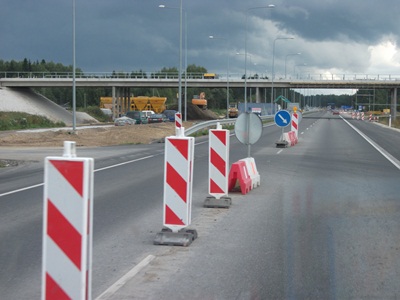
Building new road


Boulders!


It was here that we said goodbye to Matt and Sarah.  They were headed back to Tallin, to catch the ferry and spend a couple of days in Helsinki.  We continued east and stayed the night just outside the National park.  The next day we headed east to the Russian border.  We went through Sillamae, full of Soviet style housing blocks and crumbling roads.  Right on the border, is Narva, Estonia's third largest city.  At this stage, we were still very uncomfortable about leaving the van.  We headed to the information centre, and then on to see Narva Castle.  The castle looks out on Ivangorod Castle, which is on the Russian side.  Next to the castle is the border checkpoint.  Upon entering Narva, we felt as though we were already in Russia, due to the vibe and outlook of the place, but it was interesting all the same.  Sadly, a lot of the roads and buildings are in disrepair, however that also means there are lots of roadworks!  We headed south to Tartu, Estonia's second largest city, that afternoon, as we had decided in advance that we didn't want to spend the night in Narva.

Border Crossing

Narva Castle (Estonia) on the left and Ivangorod Castle (Russia) on the right


The following day we solved our computer issue!  Dale had found a secondhand computer shop on the internet in Tartu, so we set about finding that.  We had seen the cheapest small laptops in the shops new for 300-350 euro, which we knew we wouldn't get back from the insurance company, as our netbook was 2 years old.  We ended up buying an old Acer Aspire one, and is the best for us considering the circumstances.  Dale did a great job bringing everything back up to date for us.  We have lost some photos from Denmark and all from Sweden, and we spent an hour or so re inputting our expenditure sheet into Excel.

In amongst this we managed a good walk around Tartu, a University city.  I felt it had a good vibe to it, and was full of University students.  It is known for it Town Hall, leaning art museum, main University building and a statue of two lovers kissing under an umbrella (which is in the Town hall square).  There is also a Botanic Garden worked on by the University students and ruins of a Dome church.  My favourite part of Tartu was the fun we had at the Market hall there.  We were parked in the carpark, so thought we would go in for a look.  We came out, having spent 11 euros, which got us 1kg mince, 4 drumsticks, 500g pork, onions, plums, pastries, bread, 10 eggs and 1kg potatoes.  Raspberries that we had seen at 5 or 6 euros in Helsinki were 1.80 euro!

Town Hall and Lovers kissing statue

Main University building

We finished our time in Estonia that afternoon by visiting the towns of Valga, Estonia and Valka, Latvia.  The towns are separated by the Estonian/Latvian border.  It is a fascinating place.  We saw the old border crossings, which recently were in force between 1990-2007, after independence and before both counties because part of Schengen.  They were also unified during the Soviet time.  Stopping here gave us an opportunity to walk between tourist information centres in both counties and to get some Lats at the ATM, for our venture into Latvia.