Monday, 19 August 2013

Finland Part 1 - Aland

We had to travel north from Stockholm for about an hour to catch our ferry to Aland.  We made short stops at Vaxholm and Norrtalje.  We arrived in plenty of time for our ferry and the ride was smooth. Due to our inability to read Swedish and lack of awareness of a time zone change it was 1 hour shorter than we thought.  In fact just as I was thinking one hour to go, I noticed we appeared to be moving very slowly and turning. So I went to investigate and noticed we were docking and most people had returned to their cars (we had been unable to hear announcements due to the engine noise).  So we hurriedly headed back to the van and all was well.

We have a ferry to Turku booked so are staying 2.5 days in the Aland Archipelago.  It has 6,700 islands (60 inhabited), 28,000 people and is a self-governing Swedish speaking region of Finland.  When Russia controlled Finland between 1809 and 1918, it was the westernmost point of Russia.
This has resulted in several sites related to Russian occupation.  Such as our first stop after arriving was the Post and Customs building on Eckero.  It is on the coast on the edge of a small village and seems entirely too substantial for the remote island setting.  The local Art Association had an Anniversary exhibition which was nice and a couple of people were doing singing practice/lessons or such giving an ambience to the area.  There was a museum regarding the post and customs you could pay for but this was already shut for the season (which for some things is as soon as the end of July) and held limited appeal.
Post and Customs Building

Aland has something like 16 churchs so we checked out St Lars on Eckero was could be described as small but perfectly formed, with wall paintings and we made it a lunch stop.


Driving nearly all the way across the main islands in about 20 minutes we next visited a church in Saltvik but it wasn't open and then found our actual intended destination Borgboda Ancient Site (Note to people who make tourist brochures CO-ORDINATES PEOPLE.   Everyone has a satnav now).  I mean seriously the guidebook lists things to see with no address only the nearest town and symbols on a small map of the entire archipelago, if it weren't for the reasonable street signs we might never find anything.
Anyway rant over Borgboda was interesting, there was a little bit of English on the signs which was handy and I made some new friends (see photos).  The site is an Iron Age hill fort where the local farmers came to defend themselves from enemies.


Aland also has a free open air museum called Jan Karlsgarden with about 20 buildings designed to give a picture of Aland farming life in the mid to late 1800s. Last stop of the day was Bomarsund where the Russians tried to build a fort but it was destroyed by the British and French in 1854, while some buildings were only foundations.  If you like ruins/foundations and/or the Crimean War this is for you but the setting is nice for a walk around too.
The next morning it was actually back to Kastelholm Castle which is adjacent to the open air museum, costs 6 euros and probably doesn't represent the best value we've encountered.  It has been well conserved (completed 2001) for it's protection and is the only medieval castle on Aland.  They have a few information boards and a small re-creation of the interior and were also displaying works by a local artist throughout (the art was of a rather grim/disturbing style - there were warnings at the entrance).  However about an hour was plenty.
Not a lot achieved in the afternoon a bit of driving around (by Nicky :-)) and looking at stuff of little consequence.  Our one small highlight was going right to the bottom of Lemland Island to a nature reserve and finding a bird watching tower which although there were no birds gave us a great view over the sea.
The following day we drove into Mariehamn, which is the main town on the island.  11,000 of Alands 28,000 residents live here.  A 4 masted Scottish sailing ship called Pommern (now and museum and well conserved) is docked near the ferry terminal.  We walked along Torggatan (pedestrian street) and bought Aland stamps at the post office (something of a collectors item).  Dale chose stamps featuring birds an wildlife. We made our way back to the van via the water front on the eastern side and past the Aland church.  We were due to check in for the ferry to Turku at 12.45pm.  The check in for the ferry was slow, and once on board, the ferry set off straight away.  It had come from Stockholm and picked up passengers and cars in Mariehamn and then we were headed to Turku in Finland.  The ferry was 5 1/2 hours long, and we spent time on the boat decks (it was a sunny afternoon), using the wifi and having our picnic food we had prepared earlier.  We arrived in Turku at 7.15pm, and the next blog will continue from there.

Midsummer Pole - every town in Aland has one
 View from the bird tower
 Pommern
 Not our ferry but ours was the same but red and pink

Monday, 12 August 2013

Stockholm, Sweden

Access to internet means the updates keep coming.  Where we left off we had one more day until arriving in Stockholm, so we woke early and started sightseeing at 8am.  We had stayed near Anundshog, so we headed there first.  It is a mound and stone ship (standing stones laid out in the shape of a ship) burial site, like what we saw at Jelling in Denmark.  It originates from 500-1050AD.  The site was used later in the middle ages as a gathering point to settle legal disputes and sentence criminals until 1450.

Next stop was the town of Uppsala.  Although we have a huge piles of pamphlets, we had no town map for here. We figured we would see the typical town map boards for tourist unfortunately they don't appear to have them so just had to follow our nose!  We saw the Cathedral (just got in before 11am Mass), the Castle and the Botanic Gardens where a petanque tournament was taking place.  We were tempted to visit the house and garden of famous Swedish Botanist Carl Linnaeus, but as we are on a tight budget we decided not this time.  Carl Linnaeus is famous for his classification of plants and animals.  There was an English bookshop in town which we also looked at.  Dale picked up a secondhand book for 10 kroner (1.15 euro).  I had some bad luck and the arm of my prescription sunglasses came off.  So I think I may need to do a good job with some tape until we get back to New Zealand.


 Carl Linnaeus home in Uppsala

After leaving Uppsala and managing to find a map at the Hammarby farm (see below) we checked and we had found the major sites, and only missed the main University building.
We headed south toward the town of Sigtuna stopping at 3 points along the way.
1.  The Stones of Mora, fragments of runestones that commemorate coronations of Swedish kings stored on the site of the coronations.  As in the past most stones have been destroyed the fragments that are left aren't all that important.
2.  Hammarby Farm, which was owned by Carl Linnaeus.
3.  Then to a lake where it was time for swimming and sunbathing.
Sigtuna is reputedly the oldest town in Sweden, from 970.  It has a lovely main street called Stora gatan lined with wooden houses and is on the lake front.

Hammerby Farm - Linnaeus

The following morning we arrived at my cousin Rebecca's in Stockholm. We received a very warm welcome and promptly set about catching up!  We had a fika (Swedish term for having coffee and cake, morning or afternoon tea) with iced coffee and cinnamon buns (another Swedish specialty).  Then it was off for a walk around the lake near their house with Benjamin (3.5 years), Olivia (2 years) and their dog, Hobbe.  Becky owns a few travel guides, so we have also been looking through those for ideas for Finland and St Petersburg.

The next day I started with a run. I've lost most of my fitness, and managed 25 minutes!  It was another hot day and we headed into the city.  Dale and I had a walk around the old town.  We have heard good things about Stockholm and we weren't disappointed.  The buildings are amazing and we were taking many photos.  We then headed to Skansen, which is an open air museum and zoo.  It was started in 1891 and features many Swedish farm houses, native animals and there is a children's zoo.  There are also some good views of the city from there.


Another day we visited Drottningholm Palace on the edge of the city.  Since 1981 it has been the residence of the King and Queen and is also a UNESCO site.  The grounds are free to walk around and we went into the palace at 2pm for a 45 minute tour.  The tour guide was very good and the only source of information as there aren't any room guides or text.  After the tour we re-visited the rooms for a closer look for another half an hour.


The following day we went into Stockholm with Joachim, Becky's husband kindly giving us a lift in the car.  The focus of the day was the History Museum (FREE on friday) where we arrived on opening and stayed for 4.5 hours including a 30 minute guided tour of their Viking period section.  We also saw art (almost exclusively religious) from the middle ages (of note two church pews from the 16th and 18th centuries- very cool) and an exhibition of the past 900 years of Swedish history.  We left about 3pm and went for a walk as far as the island of Soderhalm.  It had been a grey and rainy morning, which cleared in the afternoon, reaching 19 degrees.  On the way back to Joachim we saw a delicious looking cinnamon pastry and couldn't help ourselves.


Becky and Joachim went away for the weekend, and we chose to drive into Stockholm on Saturday (free parking on weekends).  We headed toward the Royal Palace as we wanted to see the Changing of the guard at midday. We went via the Jewish Synagogue.  We took a picture each and surprisingly we were approached by a security guard and questioned about our presence there.  Unfortunately, as the guard said, the Synagogue requires such security.  We reached the Palace and positioned ourselves to see the mounted procession approach, which was made up of armed guards and musician guards all on horseback.  We moved again to see them close up as they approached the courtyard of the Palace, and then again to see the goings on in the courtyard.  Unfortunately for the main part we had a very poor view as we weren't there to save good spots before the ceremony.  I suppose if we were to go again we would position ourselves in the courtyard to get a good view of the main show.  For lunch we headed to the park Kungstradgarten, where Brazil day was happening- including stalls, a concert and football games.  We stayed and watched a performance by two clowns, which was very entertaining.  They sat on unicycle and used a jump rope at the same time, juggled and did back flips.  Our next stop was the Concert hall, which is where they hold the Nobel Prize ceremony.  There is a exhibition on until the end of the month, with panels and pictures about the event.  We had a look through the food hall next door, which was very interesting.  They were selling an array of seafood, meat, spices, nuts, fruit and vegetables.  Swedish prices can get a little scary we spied a burger pattie for 25 kroner (2.90 euro) and a miniature cupcake (half a mouthful at most) for 20 kroner (2.30 euro).  We headed back to the van and embarked on a special journey to buy LPG from then only station on the outskirts of the city.  This was a bit of an adventure in itself as we passed through city streets, a tunnel with a maximum height of 3 metres (our van is 2.9), motorways and more tunnels (one was 4km in length).

We spent Sunday afternoon with the neighbours Erik and Maryanne, who took us to the neighbouring municipality of Taby, to visit the Taby Church and some rune stones, driving back via Vallentuna lake.  Taby Church was beautiful with original ceiling paintings- 66 in total mainly based on the old testament. It was one of the most memorable churches I have seen so far.  We joined Becky the following day for lunch at Kura- a kiwi inspired cafe run by 2 New Zealanders.  I enjoyed having a flat white and some rocky road to finish!  We stopped at a palace called Ulriksdal on the way home, not far from Becky and Joachim's home.  It is on the lake front and we enjoyed a walk around the grounds. Tonight we will have a meal with the Becky and Joachim, before leaving tomorrow.  We have been blessed to stay with them this week, and they have been very hospitable, as have their neighbours Erik and Maryanne.  It has been a very memorable week in our holiday so far.  My running has also improved- up to 40 minutes now and not wanting to stop along the way.  Tomorrow we head to Alund, an island between Sweden and Finland, and then on to Finland.


Thanks for reading everyone :-)

Saturday, 3 August 2013

Gothenburg and Orebro, Sweden

For the next two days we worked our way north to Gothenburg.  We used the coastal route and on the first day we spent time in the Varberg area.  The town was heaving, so we didn't end up stopping there, as we couldn't find a park.  We continued on to a headland called Gretterons.  Adjacent there was a wetland nature reserve where Dale looked at waders.  Then I wanted to go to the UNESCO site in Grimeton, where they first transmitted a wireless signal across the Atlantic, morse code to New York.  We arrived on closing time, but would have opted for a free walk around the grounds anyway and did so.  The site was built in the 1920s and the primary array consists of 6 large (127 metres high) towers.

The following day we started with a visit to a Nuclear power plant at Ringhals.  It is always nice to see different attractions whilst away, so we were interested to go as we have never been to one before.  This one is run by Vattenfall, and is 1 of 3 in Sweden.  It has 4 reactors built in the 70's and early 80's.  There is a free information centre there with a film and interactive exhibition.  The visit also consisted of a ride in the land train around parts of the plant.  They take security very seriously- ID is required to go on the tour and there are to be no cameras or phones also.  There was plenty of English and information about energy as a whole.  Still not a fan of Nuclear, but good to at least be more informed about it.  From the information presented it seems that Sweden has a comparatively good balance of coal, nuclear, wind farms, biofuel etc. for electricity in terms of economics, availability to consumers and impact on the environment (in comparasion to the global averages, which are really bad by the way).

Grimeton UNESCO site


Vattenfall Nuclear plant


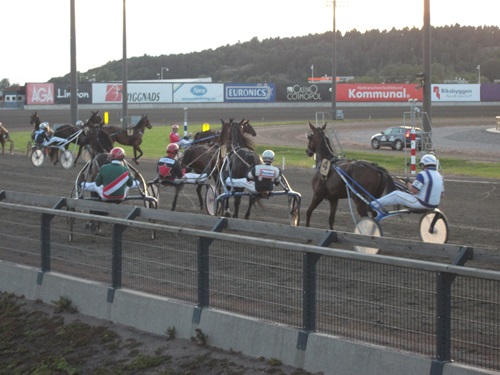
We had a quick swim and some lunch before stopping in Kungsbacka, a market town.  We were lucky as we arrived on their once a month market day.  We tried to find the visitor centre, but after half an hour of walking in loops following ambiguous signs we gave that away.  We then drove the 20km to Aby Travet racecourse on the outskirts of Gothenburg.  The harness racing started at 6.30pm.  The track and facilities were very good and reminded us of Addington Raceway.  We were able to see from the 1st floor, through glass, into the horse stalls below.  Before one race we watched a female driver head out to the track with the horse.  She won, so we watched her collect the ribbon trackside and then back to the stalls where her fellow competitors were congratulating her. There were 10 races in all, finishing about 10pm.


The following morning was a trip into Gothenburg.  We had looked in the brochures and found nothing stood out that we wanted to see, so we parked for 3 hours and walked around the city, the marina and along the canal.  Between the Marina and Opera house are 3 small trampolines built into pits so they are at ground level, which amused us for a good 10 minutes (see photos) and there was a small climbing wall.  We walked through the Botanic gardens and the glasshouse and had a picnic in a park.  Overall a nice city, but didn't have any wow factor for us.  Like everywhere in Scandinavia we have seen so far it seems  a perfectly pleasant place to live.

It is Friday afternoon by this stage and we are visiting my cousin Rebecca and her family in Stockholm on Monday, so we sketched out a plan of where we would go over the next two days on the way there.  We had asked at the visitor centre in Gothenburg, and they were able to provide some brochures.  The lack of a large area map meant we were unable to get the attendant to exactly understand the 2 routes we were trying to choose from.  So after about half an hours reading we realised only one brochure would be relevant and it was in Swedish.  At least she tried, and the Swedish tourist centres are well equipped with regional information.  We haven't had much luck when enquiring about other parts of countries before.  Like in Plzen, Czech Republic we saw a map on the wall of West Bohemia (which we ended up buying) we asked 'is there was anything in the surrounding areas similar to the types of things marked in the wall chart (churches, monasteries, castles, manor houses, etc).  We got a funny look and were advised, 'we are info centre for Plzen'.  Bit like being Christchurch tourist info and not being able to advise about Akaora or that Kaikoura is worth a stop if heading to Blenheim, or Arthurs Pass when going to the West Coast, or don't stop in Ashburton :-) when heading south.

That evening about 100km from Orebro, we did visit Sjotorp and the Gota canal and saw two locks where it begins by the lake (which I admit we did have a brochure for!)  The areas along the canal were very popular with motorhomes and we passed several overnight areas with services, all for a substantial cost though.

We started the morning with a visit to Hova visitor information, which is housed in a purpose built castle for their medieval festival each year.  We were pointed in the direction of an area for swimming at lake Vanern.  The area was enclosed by a campsite and a beautiful spot.  We suspected any of the caravan sites about 10 metres from the waterfront would be booked solid every summer.  The water was really refreshing and we sunbathed on the sandy lake front.  After lunch we headed to Orebro.  We arrived late afternoon and commenced a walk around the city to see the castle, church and open air museum.  There were several, very interesting works of modern art located around the city and the castle and nearby bridge were very picturesque.  The city appeared to have a lot going on, there were many bars and restaurants gearing up for a busy Saturday night ahead in the heat (30 degrees when we were walking around).  On the way back to the van we walked through the open air museum called Wadkoping- a collection of buildings from the 17th, 18th and early 19th century.  There is a cafe, craft shops and a museum among other things located in these buildings.  Hitting the road again tonight to get a bit closer to Stockholm.

Gothenburg


The Gota canal


Orebro Castle


Orebro Open air museum


Thursday, 1 August 2013

Catching the ferry, beaches and towns of Sweden!

Our last morning in Copenhagen was spent with a walk around the Carlsberg Brewery complex and to check out a market that had been listed in Copenhagen's only English newspaper. I thought the market was a bit of a let down.  Every stall was selling secondhand goods with nothing of real interest ie. old clothes and toys.  We had a picnic in the park nearby and then headed north to the outer suburbs where we went to the Frilandsmuseet.  It is an open air museum of around 80 buildings from Denmark and Sweden between 1600-1950s.  There were several farm houses.  Many of them in a square formation with a courtyard in the middle, or as a long building with animals in one half and the family in the other.  There were also waterpumps, windmills and a Swedish bathhouse.  There was a singing and comedy performance put on by staff members in period dress and we spent the rest of the afternoon there.

The following day we headed up to Hillerod, where Frederiksborg Castle is located.  After a quick stop at the Aldi, we were there about 10.30am.  We had decided not to get audio guides as they required you to leave an ID which would be returned upon return of the audio guide.  I'm reasonably against this as the ID would have had to be a license, passport or credit card.  So we went inside to the first two rooms where we saw a lot of Danish text.  I suggested to Dale that we go back and get audio guides as otherwise our experience here might not be as good.  So we returned to be told that they had no guides left as many tour groups had been through that morning.  It was after 11am at this stage so we decided to wait, which took about 15 minutes, and in the end was worth it.  We took 2 hours touring the castle which doubled as a National History museum.  The history is mainly portrayed through paintings with a few objects as well.  Unlike most museums it is not heavy in written text to read.  We spent an hour in the gardens having lunch and walking, before returning to the castle where we went up to the top floor to look at the modern history which isn't included in the audio tour.  This took another hour.  Overall a nice day at the castle.  It was packed with Aisan tour groups and there were a few Americans as well.  We feel there could be some simple changes that could be made to make it a better experience for the visitor.  We thought more audio guides and printed room guides (as some rooms had only Danish, or 1 Danish and 1 English copy) would be a good idea.

Frederiksborg Castle

The chapel, Frederiksborg Castle


The Great Hall


Frilandsmusset (open air museum)


We then went to Fredensborg Castle (not Frederiksborg- the names are very similar!) nearby in hopes of walking around the grounds, but this isn't possible as you have to pay to see them.  So we took a couple of photos and continued on to Helsingor, which is where we are going to get the ferry to Sweden from tomorrow.  We parked in an area next to the marina where a lot of motorhomes were using.  After dinner we walked around the outside of Kronsborg Castle, which is a UNESCO site.  We had a relaxing evening overlooking the beach and looking out at the lights of Sweden across the water.

The next morning we walked into Helsingor in order to spend our remaining cash of 30 kroner (about 4 euros). The town is lovely and we managed to buy 500g grapes, 150g cherries and cheese.  We found out from the information centre that it is cheaper to buy your ferry ticket online (46 euro instead of the normal 52 euro).  This cost is for a 20 minute ferry ride!  These are July/August prices.  So as we had got wi fi last night from where we were parked, we tried again, to no avail.  We even parked near the information centre as they usually have wi fi, to no success.  So we had to pay the 52 euros.  As I said the journey was very short.  Essentially sitting on the passenger deck for 10 minutes then returning to the van.  We noticed people in one car, so you must be allowed to stay in your vehicle?

Once we arrived, our first job was to full the gas tank with LPG.  We had been 17 days since we last did, and we had been thinking for the last few days that at any moment we would run out and we would have to change to our camping gaz bottle.  So we popped the address into the GPS.  The final destination was marked on the GPS on the wrong part of the road, but we continued and eventually came across it.  We were very lucky as they even accepted our UK Visa card.  We headed north and stopped in the first town we saw called Bastad, to withdraw cash and to go to the information centre.  Both those achieved we walked down to the beach and the marina.  We watched some novice wind surfers having a lesson.
We had a late start the next day and continued to head north.  Our first stop was the town of Laholm and the information centre.  We picked up a guide there on all the  motorway rest stops in the country, where we can fill up with water and empty waste, and some other useful brochures on areas we plan to visit.  The attendant there was very helpful and also gave us a self guided town walk which we could do.  Attached to the information centre was the drawing museum which we had a look in and featured life drawing.  We went back to the van as it was raining.  The shower was short and we completed the town walk afterwards.  The map was drawn by hand and quite ambiguous, which made it hard to follow.  The town is one of the oldest in Sweden.  We left the town mid afternoon and headed to Tylosland, via the Lidl supermarket.  We found that most things in the supermarket were a little cheaper than in Denmark, which may just be the exchange rate with the euro.  We got to Tyloland beach, which is supposed to be one of the best in Sweden.  The sun had come out by this stage and it had got to about 25 degrees, so we were ready for a swim and weren't disappointed.  There was lovely golden sand and no jellyfish!  We were both able to go out to our shoulders and there were lots of waves.  It was the most enjoyable swim I have had so far on our holiday.